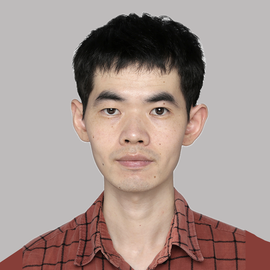
何佳程
讲师
重庆大学
Jia-Cheng He
Basic Information
- Date of Birth: February 10, 1991
- Nationality: China
- Email: [email protected], [email protected]
- ORCID: 0000-0002-7409-7728
- CV
Research Interests
- Altermagnetism and topological superconductivity
- Unconventional superconductivity
- Strongly correlated electrons
- Phase transition
- Quantum magnetism
Research Experience
Theoretical Study of Unconventional Superconductivity in Bi/Ni Bilayers (Oct 2015 - Jun 2018)
- References: arXiv:1810.10403, PRB 106, 224508 (2022)
- Our theoretical conductance spectra of the Anderson-Brinkman-Morel (ABM) state can explain the main features of the point contact Andreev reflection (PCAR) spectroscopy results of the epitaxial Bi/Ni bilayers.
Theoretical Study of Correlated Insulator Behavior and Unconventional Superconductivity in Twisted Bilayer Graphene (TBG) System (Sep 2018 - Nov 2020)
- Reference: PRB 105, 245117 (2022)
- We develop the Gutzwiller approximation method to obtain the renormalized Hamiltonian of the SU(4) t-J model with the corresponding renormalization factors.
- The feature of the superconducting dome in our results in the vicinity of quarter filling is consistent with that of the superconductivity observed in TBG. Corresponding to the region around the charge neutrality point of TBG, the superconducting state does not exist in the case of hole doping away from half-filling, which is also consistent with TBG experiments.
- Corresponding to the region around the charge neutrality point of TBG, the superconducting state does not exist in the case of hole doping away from half-filling, which is also consistent with TBG experiments
Numerical Study of the One-Dimensional SU(4) t-J Model (Sep 2020 - Apr 2022)
- Reference: Jia-Cheng He, Jun-Hao Zhang, Jie Lou, and Yan Chen, Six-component pairing instability in the SU(4) t-J chain, arXiv:2311.06601
- We use the density matrix renormalization group (DMRG) method to study the SU(4) t-J chain. We find that, in addition to the conventional repulsive Luttinger liquid phase and phase separation, there are two phases in the attractive Luttinger liquid region dependent on whether the flavor gap is opened or not. The first with the flavor gap is the molecular superfluid phase (the SU(4) singlet instability) which is well-known in the attractive SU(4) Hubbard model $( U < 0 )$ ). The second without the flavor gap is the superconducting phase (the six-component pairing instability). Furthermore, the molecular superfluid instability cannot coexist with the superconducting instability. This is general in ${ \mathrm { S U } } ( N )$ models with $N > 2$ and is well demonstrated by the theoretical analysis based on the phenomenological bosonization results.
Work Experience
Fudan University (Apr 2023 - Feb 2024)
- Research Assistant, Department of Physics
Chongqing University (Apr 2024 - Present)
- Youthful Teacher, Centre for Modern Physics
Publications
Jia-Cheng He, Jie Hou, and Yan Chen, Gutzwiller approximation approach to the SU(4) t-J model, Phys. Rev. B 105, 245117 (2022).
Jia-Cheng He and Yan Chen, Evidence of triplet superconductivity in Bi/Ni bilayers: Theoretical analysis of point contact Andreev reflection spectroscopy results, Phys. Rev. B 106, 224508 (2022).
Jia-Cheng He, Jun-Hao Zhang, Jie Lou, and Yan Chen, Six-component pairing instability in the SU(4) t-J chain, arXiv:2311.06601. (submitted to Phys. Rev. B)
G. J. Zhao*, X. X. Gong*, J. C. He*, J. A. Gifford, H. X. Zhou, Y. Chen, X. F. Jin, C. L. Chien, and T. Y. Chen, Triplet p-wave superconductivity with ABM state in epitaxial Bi/Ni bilayers, arXiv:1810.10403. (* Equal contributions)
Conferences
Physics Summer School, Stockholm, Sweden (Jun 2018)
- Conference: Quantum Connections - The School: Recent Advances in Quantum Phenomena
The 12th International Conference on Materials and Mechanisms of Superconductivity and High Temperature Superconductors (M2S-2018) (Aug 2018, Beijing, China)
- Website: www.m2s-2018.com
- Contributed Poster: Theoretical Formalism of Andreev Reflection Spectroscopy for Three-dimensional Triplet Pairing Superconductors
Skills
Analytical Techniques:
- Proficient in group theory and topology
- Proficient in quantum field theory in condensed matter physics, including functional integral techniques and Feynman diagrams
- Proficient in bosonization technique and Luttinger liquid
Numerical Methods:
- Proficient in the Bogoliubov-de Gennes (BdG) method
- Proficient in the density matrix renormalization group (DMRG) method
Programming Languages:
- C/C++, Python, MATLAB, Mathematica
Languages
- Chinese: Native
- English: Fluent (speaking, reading, writing)
- Altermagnetism and topological superconductivity
- Unconventional superconductivity
- Strongly correlated electrons
- Phase transition
- Quantum magnetism
Youthful Teacher 2024.04-Present
Centre for Modern Physics, Chongqing University
Research Assistant 2023.04-2024.02
Department of Physics, Fudan University
Ph.D. in Theoretical Physics 2014.09-2022.08
Fudan University, Shanghai
B.S. in Physics 2010.09-2014.06
Chongqing University